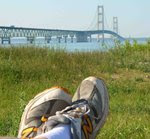
HARTLAND TOWNSHIP, Mich. — Well, my last post was 10 days ago. That's not what you want to do while blogging. Typically, you want to have content at least once a day if not more. But I have been busy. I did attend the Online News Association’s Parachute Training seminar Thursday in Ann Arbor. There was a lot of good tips about Twitter and how make yourself noticed as a blogger. One of those was to try to create a buzz about your content by not sharing everything … so let me just say I'll be incorporating many of those tips in upcoming posts. Come back often to find them.
HARTLAND TOWNSHIP, Mich. — A Monday posting from E-Media Tidbits provides some good tips that we should keep in mind once we start creating our blogs soon on how to best integrate Web-sharing tools, such as Twitter.
HARTLAND TOWNSHIP, Mich. — Kaitlin D. sent this link from the Canadian newspaper The Globe and Mail about the Taliban.
Here are Kaitlin’s comments: “While searching for an example of multimedia journalism, I stumbled upon “Talking to the Taliban,” as well as the story I chose. I found the Web site for this particular piece of journalism to be outstanding. Not only are there plenty of videos to keep me interested, but I loved how organized it was. There was so much information, yet it was neatly compiled according to the date it was written and further categorized into an introduction and parts one through six. There was also plenty of photographs and even maps and graphics to explain what the text said. I was thoroughly impressed with the organization and level of commitment this project clearly took. It is definitely not something that was put online quickly. It seems to have been very well thought out. And, as is the objective of journalism, it also taught me a lot. It gave me a deeper insight into the Taliban as well. Overall, I thought this was an exceptional piece of multimedia journalism. It also won an Emmy, so I assume I am not the only one who found it very thought provoking and outstanding. :)
Here are her comments: “Google has yet another new feature out trying to revolutionize the internet, the Google wave. This article even touches a bit on how the features of Google Wave can be used for journalism. What I find interesting about Google Wave is that it's very exclusive at the moment, kind of like facebook used to be. You have to have an invite to use it, but my gay ex boyfriend's friend he made at Swiss Business school used to intern at Google has super invites, so he's allowed to invite more than eight people. I commented on his status and asked him to invite me, so hopefully I get to try it out. I figure since we're already focusing on a Google feature this week it's interesting to read about a potential new feature of Google.”
BTW, this extends her lead over everyone but Lorry N., who has taken over second place by herself. Want to get in on the action? Send me a link or comment on this post or others here.
HARTLAND TOWNSHIP, Mich. — Jennifer Serwach took the lead in the extra credit contest this week for her willingness to explore Second Life and report back, earning three extra credit points. That's the typical maximum you can earn in one week. She is now 11 points away from at least a 1 percent grade boost.
HARTLAND TOWNSHIP, Mich. — Back in Chapter 4 of “Principles of Convergent Journalism,” the text talks about Google Earth and discusses how journalists in Chicago have used crime data to make interactive maps with Google, showing crimes on a block-by-block basis. In Chapter 10, we're once again talking about adding multimedia.
One of your assignments this week is to make a simple Google Map. I've done one which you can view below the help video. It shows where I have run marathons (As a reporter, I had A LOT of stress covering Flint City Hall and dealing with editors, so I became a runner. I lost a lot of weight, too). I did it by creating a Google account and following their instructions in the video below.
Next is a wide shot of where I have run marathons. My dad likes to tease me about where I have gone, saying if I want to run 26.2 miles, all I need to do is put on my shoes and run out my front door. Why travel thousands of miles? I hope to run a marathon again in Detroit on Oct. 18, but I will bail if my wife is in labor.
Lastly, we have a zoom of New York, where I ran the marathon in 2007 (I created both of these images using the customize embed feature). I thought I could run with Lance Armstrong and I blogged about my experience while I worked for The Flint Journal. I was wrong, but I did get a cool medal. Click on the placemark for a photo that I accessed through Flickr. We'll focus on Flickr more in a few weeks, but if you want to put a photo in, you'll need a place to host your images, so I set up my own account there.
HARTLAND TOWNSHIP, Mich. — So, here I am trying to figure out how to sit down on an log and I sit in the fire. Ouch, that hurt, I think?
That's how well my foray into Second Life was. Like Jennifer Serwach said on the Discussion Board, I wasn't that impressed with the interface or the virtual world itself — although after I did sit down some stranger walked up to me and asked me in Spanish if I wanted to be his friend (Not exactly like Facebook, eh?).
What I found more fascinating is how these people are writing and producing their own stories about this virtual world. Can't make it as reporter in the real world? Maybe you can make it in Second Life, a place with its own economy and problems just like the other world we share, although MSM, such as Reuters, has already cutback its own bureau in SL (just like the RW).
Here are her comments: “So this article basically says that there's rumors of Apple releasing a product similar to the Kindle. As we all can tell from the iphone, Apple tends to revolutionize technology so perhaps the Apple alternative to the Kindle will be even more unique and revolutionary. If Kindle catches on more mainstream, that could impact newspapers greatly since the Kindle has a lot of features for seeing a newspaper in more of the form that you would see in print. And since Kindles aren't backlit in the same ways computers are they tend to be easier on the eyes. So more companies creating products similar to a Kindle means that they're catching on and that could help the news industry in the long run.”
Here are her comments: “Check this website out - I believe it's just a blog but I never knew about this event. It seems like it would be very interesting to get on and watch. But, I'm not sure if it's open to the public or not! Lorry N.”
Update 10:37 a.m.: I received a message from one of the organizers. There's no problem if you sign up the day of the event. Also, the start of the day goes like this: 9:15 a.m. coffee, welcome remarks 9:45 a.m., first session 10 a.m.
HARTLAND TOWNSHIP, Mich. — Interested in learned new journalism skills and brushing up on ones you already know? The Michigan Collegiate Press Association is hosting its fall workshop “ABC Easy as Attitude, Basics and Convergence” from 9 a.m. to 4 p.m. Saturday at Eastern Michigan University.
The slated sessions include “Going Online Only” and “Adapting to a New Media Environment.” The cost is $20 for members and $30 for nonmembers. An RSVP deadline was Sept. 18, but I would think they'll be flexible (I'm checking into it).
If anyone goes and writes about what they learned from one of the online sessions for a posting here, it'll be worth three extra credit points (Please email if you plan on doing that).
YPSILANTI, Mich. — Marla D. sent this link about Web site usability and how eyetracking studies have helped in Web site design (I'm posting this from Eastern Michigan University, where I'm also teaching a feature writing class). Here are her comments:
“I was astonished after reading this article on usability of a web page. The technology that was used to follow a readers eye patters on a home page or photos really proves that the content, layout, colors and graphics play a huge role in how effective the information is being relayed. I can relate this article to the comparing website assignment we just did. I thought one of the home pages was far too cluttered and my eyes kept jumping around.
Enjoy,
Here are some tools an online journalist can use. They include a MacBook Pro, a Flip video camera, a digitial audio recorder (also beneath the camera and an AP stylebook is our textbook).
I currently teach journalism classes online at the University of Michigan-Flint and I work on the Digital Operations Team for MLive Media Group. Any questions or comments? Please e-mail me at cmachnia@umflint.edu.


 Posts
Posts